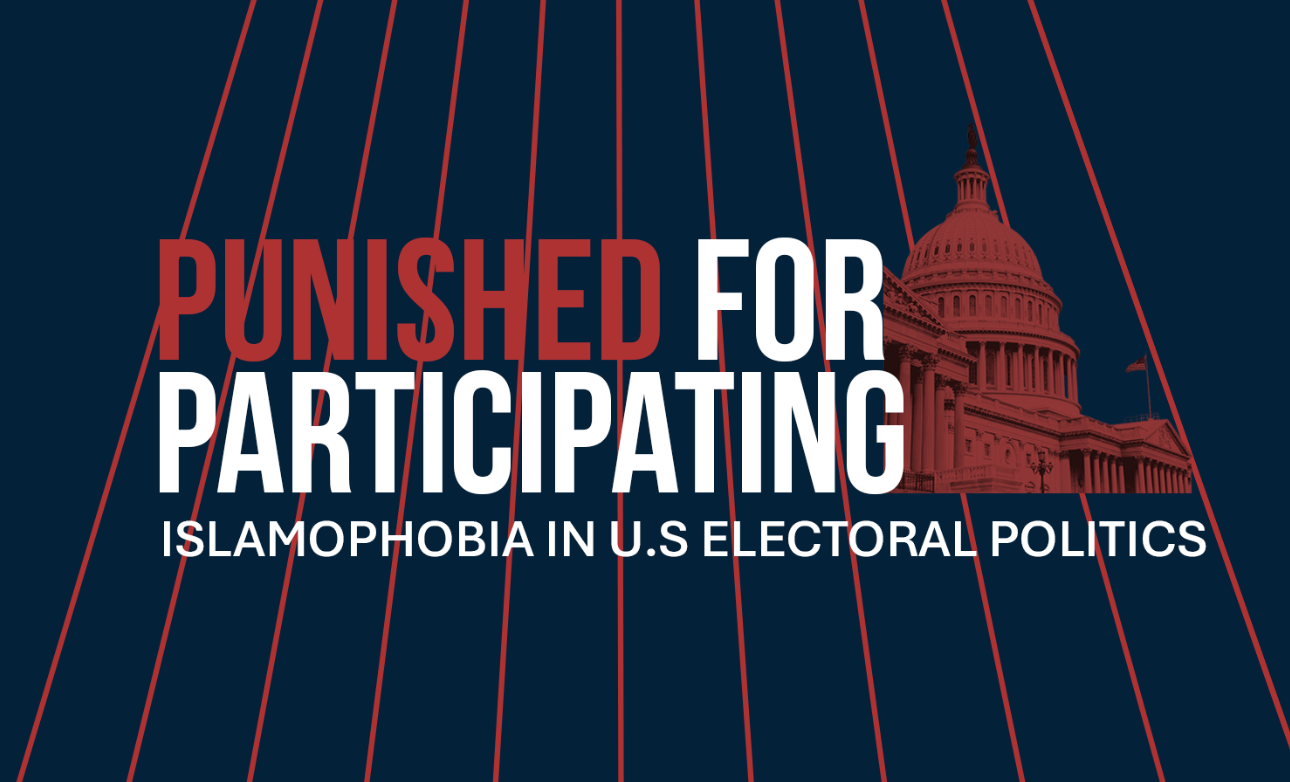
Punished for Participating: Islamophobia in U.S. Electoral Politics
By the summer of 2026, more than 255 Muslim Americans were elected officials, including four in the U.S. House of Representatives and three more predicted to win in the November Congressional elections. But rather than be embraced as engaged fellow citizens, Muslim American political candidates are encountering overt hostility and attempts to exclude them from public service.
Muslims are punished for participating in one of the most American acts—running for office in democratic elections.
Not only do Muslim Americans’ experiences contradict the fundamental American ideal of equal participation in self-governance, but they also reinforce the structural racism that has undermined this ideal since the nation’s founding. The report, Punished for Participating: Islamophobia in U.S. Electoral Politics, finds that despite historic gains in political representation, Muslim American candidates face a mainstreamed racialized backlash.
Through analysis of over thirty-one case studies of Muslim American candidates and elected officials between 2001-2026, four distinct manifestations of Islamophobia pervade electoral politics:
1) conspiracy theories of an Islamic invasion and imposition of Sharia law,
2) gendered Islamophobia,
3) political violence,
4) presumptions of antisemitism
Prevalence of these Islamophobic views is not the expected result of Al Qaeda’s September 11th terrorist attacks. Nor does it arise from good faith attempts to distinguish a small number of Muslims in the United States who commit criminal acts from the vast majority of the approximately six million law-abiding Muslims. Instead, Islamophobia is driven by a relentless fixation on casting Muslims as radicals and extremists.
Not only is this fixation grounded in erroneous racial stereotypes, but it is factually false. One need only look to the increasing number of Muslims who are literally “playing within the system” by running for office in democratic elections. Yet, this quintessential American act attracts the racial stereotyping premised on Muslims’ permanent outsider status, regardless of their individual actions, citizenship status, or civic participation.
The experiences of Muslim American candidates and elected officials documented in Punished for Participating offer a contemporary example of how racism threatens American democracy by creating different classes of citizens: a privileged class entitled to participate in self-governance and a subordinated class denied the same opportunity due to the extraordinary costs imposed on their safety, reputations, and mental wellbeing. A hostile environment where large segments of the public view Muslim Americans’ religious identity with suspicion or fear before even considering the candidate’s policy positions or qualifications chills other Muslims from running for elected office.
When Muslims are penalized for participating in the electoral process, the harm reaches far beyond one religious minority—it undermines the foundational democratic principle that allows all Americans to participate equally and safely in public service.
The report offers three recommendations as a starting point for undoing decades of socialization that has legitimized discrimination against Muslims in all facets of life, including electoral politics.
- Establish Task Forces at the State and Federal Level to Combat Islamophobia and Anti-Muslim Racism
The federal government and each state should establish a Task Force to Combat Islamophobia and Anti-Muslim Racism that is comprised of state and local government officials, educators, scholars, journalists, and diverse Muslim American civil society leaders. The task forces can learn from and build upon similar ones created to combat antisemitism across the United States.
- Train Local and State Law Enforcement About Islamophobia, Anti-Muslim Hate Crimes, and Effective Strategies for Prosecution and Prevention
Each state government should train local law enforcement on how to identify, document, prevent, and prosecute anti-Muslim hate crimes and harassment, which empirical studies show rise with the increase in Islamophobic rhetoric in U.S. electoral politics. Such trainings should include developing and implementing safety protocols for Muslim American political candidates and elected officials who are frequently targets of hate crime threats and acts. Task forces to combat antisemitism offer a useful template.
- Develop Curriculum and Trainings to Understand Muslims and Combat Islamophobia for K-12 Schools, Universities, and Government Agencies
Too often, Muslims in the United States are absent or inadequately covered in school curricula. Muslim-American history thus should be incorporated into state social-studies standards that allows for instruction concerning Islam as a major world religion, the history of Muslim Americans, Muslim immigration, Black Muslim movements and contemporary Muslim-American civic life. Likewise, existing anti-discrimination training and educational programming in public schools, universities, government agencies, and workplaces should incorporate the history and experiences of Muslim in the United States, as well as prevention of Islamophobia and anti-Muslim racism.
To read Punished for Participating: Islamophobia in U.S. Electoral Politics, click here.
We invite you to support our programming and research on the civil and human rights of Muslims and Islamophobia donating to CSRR here.

Media Coverage
These women just want to govern. On the right, many only care that they’re Muslim. The 19th News. (2026).
Munira Abdullahi was having a particularly terrible week. It was one week before the midterm elections, and her phone kept pinging: another Islamophobic post falsely claiming she was a terrorist, an enemy to America and a communist. As the first Muslim woman and first Somali American to serve in Ohio’s state legislature, Abdullahi is no stranger to anti-Muslim hate, particularly online.

When I first ran for the Princeton school board, I did something I doubt my opponents ever considered. Before knocking on a single door, I asked respected leaders in my community to vouch publicly for my character. I wanted voters to hear from people they trusted that I was a mother, a neighbor, and a public servant, not a threat. I lost anyway. In a down-ballot race, where many voters know little about the candidates beyond their names, I believe mine worked against me the moment voters read it.

The name game: Abdul El-Sayed’s Senate bid tests the limits of US politics. The National. Jihan Abdalla. (2026).
El-Sayed, El-Sayeed, El-Sayad – for months, Abdul El-Sayed, an Egyptian American running for the US Senate for Michigan, has had his name mispronounced, sometimes deliberately. US President Donald Trump has frequently mocked his name and said he would call him “Mohammed”. He has also faced relentless attacks over his Muslim faith and accusations of having ties to Hamas, the Muslim Brotherhood and Hezbollah – allegations he has vehemently denied.

DETROIT (RNS) — During a town hall meeting last week at the Shrine of the Black Madonna, U.S. Senate candidate Abdul El-Sayed acknowledged the tensions between the city’s Black residents and its Arab Americans — a tension rooted in economic inequities, race and class. If elected the first Muslim U.S. senator on Nov. 3, El-Sayed said, he will work to heal the rifts between the two groups. Then he made his plea: “I also ask that I am judged by the content of my character, not the color of my skin,” he said at the Sept. 14 event, echoing the Rev. Martin Luther King Jr.’s “I Have a Dream” speech and winning instant applause from some 100 people seated at tables in the church’s fellowship hall.

Why Are Muslim Candidates Still Being Treated As Suspects? Newsweek. Faisal Kutty. (2026).
“I’m the president of the United States, I can call you whatever the hell I want.”Donald Trump was addressing Abdul El-Sayed, Michigan’s Democratic Senate nominee, at an October 16 rally in Dalton, Georgia, after days of calling him “Muhammad” instead of Abdul. In the same remarks, Trump called El-Sayed a “jihadist,” said he hates the country, and claimed, without evidence, that he belongs to the Muslim Brotherhood. He then questioned whether El-Sayed could be trusted with a seat on the Senate Intelligence Committee.

Punished for Participating: Islamophobia in U.S. Electoral Politics with Eric McDaniel (9/9/2026)
The increase in Muslim Americans running for elected office is met with increased racialized hostility toward their Muslim identities. Islamophobic political campaigns spread racial tropes accusing Muslim candidates and elected officials of terrorism, misogyny, and antisemitism as a means to exclude them from politics. Join us for an expert discussion on CSRR’s forthcoming report Punished for Participating that examines the causes and implications of these troubling trends.