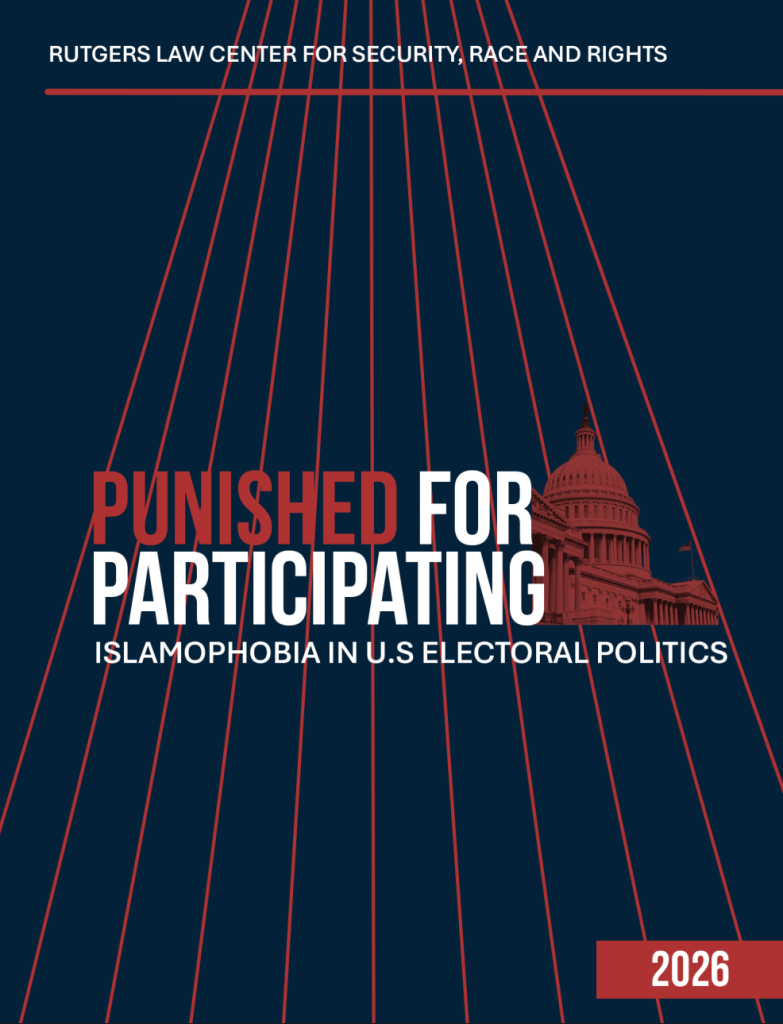
Punished for Participating: Islamophobia in U.S. Electoral Politics
By the summer of 2026, more than 230 Muslim Americans were elected officials, including four in the U.S. House of Representatives and three more predicted to win in the November Congressional elections. But rather than be embraced as engaged fellow citizens, Muslim American political candidates are encountering overt hostility and attempts to exclude them from public service.
Muslims are punished for participating in one of the most American acts—running for office in democratic elections.
Not only do Muslim Americans’ experiences contradict the fundamental American ideal of equal participation in self-governance, but they also reinforce the structural racism that has undermined this ideal since the nation’s founding. The report, Punished for Participating: Islamophobia in U.S. Electoral Politics, finds that despite historic gains in political representation, Muslim American candidates face a mainstreamed racialized backlash.
Through analysis of over thirty-one case studies of Muslim American candidates and elected officials between 2001-2026, four distinct manifestations of Islamophobia pervade electoral politics:
1) conspiracy theories of an Islamic invasion and imposition of Sharia law,
2) gendered Islamophobia,
3) political violence,
4) presumptions of antisemitism
Prevalence of these Islamophobic views is not the expected result of Al Qaeda’s September 11th terrorist attacks. Nor does it arise from good faith attempts to distinguish a small number of Muslims in the United States who commit criminal acts from the vast majority of the approximately six million law-abiding Muslims. Instead, Islamophobia is driven by a relentless fixation on casting Muslims as radicals and extremists.
Not only is this fixation grounded in erroneous racial stereotypes, but it is factually false. One need only look to the increasing number of Muslims who are literally “playing within the system” by running for office in democratic elections. Yet, this quintessential American act attracts the racial stereotyping premised on Muslims’ permanent outsider status, regardless of their individual actions, citizenship status, or civic participation.
The experiences of Muslim American candidates and elected officials documented in Punished for Participating offer a contemporary example of how racism threatens American democracy by creating different classes of citizens: a privileged class entitled to participate in self-governance and a subordinated class denied the same opportunity due to the extraordinary costs imposed on their safety, reputations, and mental wellbeing. A hostile environment where large segments of the public view Muslim Americans’ religious identity with suspicion or fear before even considering the candidate’s policy positions or qualifications chills other Muslims from running for elected office.
When Muslims are penalized for participating in the electoral process, the harm reaches far beyond one religious minority—it undermines the foundational democratic principle that allows all Americans to participate equally and safely in public service.
The report offers three recommendations as a starting point for undoing decades of socialization that has legitimized discrimination against Muslims in all facets of life, including electoral politics.
- Establish Task Forces at the State and Federal Level to Combat Islamophobia and Anti-Muslim Racism
The federal government and each state should establish a Task Force to Combat Islamophobia and Anti-Muslim Racism that is comprised of state and local government officials, educators, scholars, journalists, and diverse Muslim American civil society leaders. The task forces can learn from and build upon similar ones created to combat antisemitism across the United States.
- Train Local and State Law Enforcement About Islamophobia, Anti-Muslim Hate Crimes, and Effective Strategies for Prosecution and Prevention
Each state government should train local law enforcement on how to identify, document, prevent, and prosecute anti-Muslim hate crimes and harassment, which empirical studies show rise with the increase in Islamophobic rhetoric in U.S. electoral politics. Such trainings should include developing and implementing safety protocols for Muslim American political candidates and elected officials who are frequently targets of hate crime threats and acts. Task forces to combat antisemitism offer a useful template.
- Develop Curriculum and Trainings to Understand Muslims and Combat Islamophobia for K-12 Schools, Universities, and Government Agencies
Too often, Muslims in the United States are absent or inadequately covered in school curricula. Muslim-American history thus should be incorporated into state social-studies standards that allows for instruction concerning Islam as a major world religion, the history of Muslim Americans, Muslim immigration, Black Muslim movements and contemporary Muslim-American civic life. Likewise, existing anti-discrimination training and educational programming in public schools, universities, government agencies, and workplaces should incorporate the history and experiences of Muslim in the United States, as well as prevention of Islamophobia and anti-Muslim racism.
To read the Executive Summary of Punished for Participating: Islamophobia in U.S. Electoral Politics, click here.
The full report is forthcoming in September 2026.
We invite you to support our programming and research on the civil and human rights of Muslims and Islamophobia donating to CSRR here.